

By Michelle Stirling ©2026
In Sean Carleton and Niigaan Sinclair’s latest historical revisionist article, they try to trash the Globe and Mail for finally admitting it did shoddy reporting on the Kamloops Indian Band’s May 27, 2021, claim of finding the human remains of 215 children in mass or unmarked graves. The duo comically title their work “Putting truth and respect before reconciliation.” Somehow, they think it is disrespectful that the Globe and Mail told the truth and respected its readers, many of whom, like me, had long demanded some journalistic integrity from Canada’s ‘paper of record.’
Curiously, in none of the mainstream media reports about the ‘215’ nor in any of the many Carleton-Sinclair rants, do these words appear: “None of the allegations have been proven in court.”
It is particularly egregious to me that the Globe and Mail, and Tanya Talaga, who authored the fairy tale, won Canadian Journalism Foundation (CJF) awards for press excellence for that garbage reporting, and former publisher and CEO won a CJF Lifetime Achievement Award; in his speech he called the Globe and Mail, “a beacon of light in an otherwise dark media landscape.”
It would be funny if it was not so sad.
Thanks in part to this shoddy atrocity propaganda proliferated by mainstream media, dozens of churches were vandalized or burned to the ground, two people died in a church arson, dozens, perhaps hundreds of people’s jobs and careers were put at risk, notably tenured professor Frances Widdowson was fired, in part for challenging the ‘215’ narrative and the precepts of “Indigenous Knowledge”, and former Indian Residential School staff, clergy, nuns and priests, most of them very elderly, cannot speak of their life’s work without fear of repercussions. Some fear for their lives.
Twenty million Canadians are Christians/Catholics; some 500,000 of those are Indigenous people. Their faith has been blood-libelled and Carleton and Sinclair talk of ‘respect?’
For whom?
For the ~6,500 former students who spoke at hearings of the Truth and Reconciliation Commission, some of whom were likely recipients of Independent Assessment Process compensation, where, as their lawyers led them, the bigger the trauma the more you cash in? The former students who never bothered to mention that there were supposedly murdered children buried in the old apple orchard by the former Kamloops Indian Residential School over the course of the seven and a half years of the TRC?
Former students, some of whom may have even attended the Kamloops Indian Residential School reunion of 1977 where they could have easily arrested the many former Catholic staff members - priests, brothers and nuns - who attended the reunion on the grounds that they were perps or witnesses to the ‘215’ child murders and burials that no one brought up at that happy event.
Former students like Tomson Highway are disrespected by Carleton and Sinclair; Highway claimed that the TRC gave us 7,000 sad stories, but not the 7,000 good stories of Indian Residential School days, like his. Or like that of Eileen Ayoungman Clifton. Or that of Pauline Gladstone Dempsey, daughter of Senator James Gladstone, another Indian Residential School thriver.
Sinclair and Carleton do not even respect the work of Sinclair’s father, the late Murray Sinclair, former Commissioner of the Truth and Reconciliation Commission. They do not respect taxpayers either.
As a colleague pointed out to me, “…the TRC Report has no references to bodies of children buried in Indian Residential Schoolyards, outside of cemeteries. (Some schools have cemeteries in their yards because the schools were built close to the Mission buildings and they, of course, had cemeteries.)”
As Indigenous Catholic priest, Father Cristino Bouvette says, wherever people live, people die. Of course you needed to have a cemetery at a mission, or at a very remote residential school. There is nothing nefarious about that.
And as historian Robert Carney has written of the 1996 Royal Commission on Aboriginal People, Indian Residential Schools served as the social services and medical hubs of the day, prior to the development of such government services. He wrote: “. It would have been fair to acknowledge that many traditional boarding schools, in some cases well into the twentieth century, took in sick, dying, abandoned, orphaned, physically and mentally handicapped children, from newborns to late adolescents, as well as adults who asked for refuge and other forms of assistance.” [Bold added]
So, yes, there are graveyards and unmarked graves. My own grandfather is buried in an unmarked grave; likely the case of millions of Canadians.
The question that Carleton and Sinclair fail to address is, why did the so-called Kamloops Indian Band Knowledge Keepers not come forward and report their “knowings” to the Commission when it spent $72 million of taxpayers’ dollars on encouraging anyone to come and talk about residential schools? As we know, only one murder is reported in the 3,500-page report and that is the story Doris Young told the Commission about what she saw at the Elkhorn school. The Commission reported her statement, even though, as an adult, Young had reported it to the RCMP but they did not find such evidence. The Commission none-the-less included her accusation in the report.
But the TRC never mentioned buried children in IRS yards in its Calls to Action and never recommended that the police investigate her claim in greater detail.
The TRC was in operation for about seven and a half YEARS.
In that time, they found that 423 children died while AT Indian Residential Schools. Think of that. Over 133 years and 139 schools, sad as it is that anyone died, the number was 423 who died AT the schools.
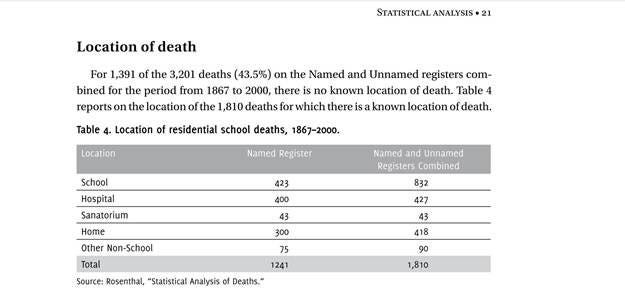
Most of the children died of Tuberculosis – endemic to all of society at the time.
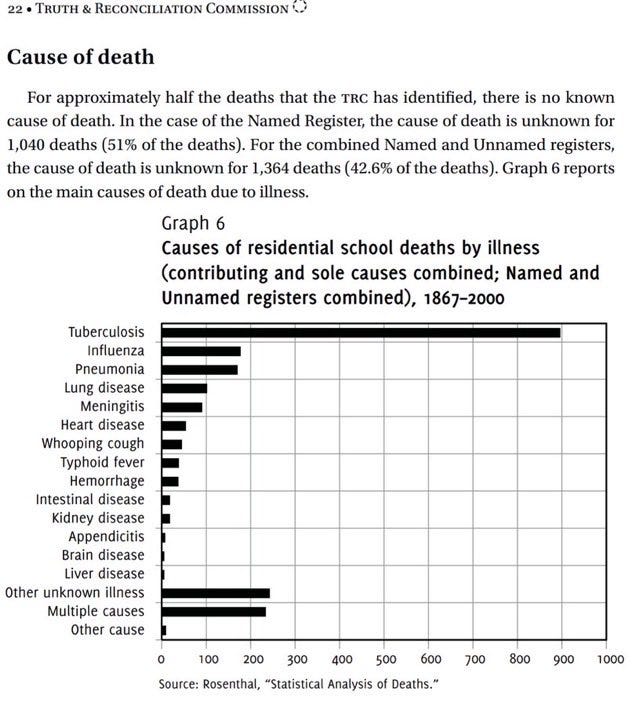
But you will say that the Truth and Reconciliation Commission and the National Centre for Truth and Reconciliation put the number at higher than 4,000. They do, but that is because they changed the counting method. They expanded the definition of a school death to include anyone who died within a year of leaving the school.
Thus, these numbers of ‘thousands of children’ repeated over and over in the media, are false. Many of those named died of causes that had absolutely nothing to do with Indian Residential Schools. That is the truth and it should be respected – in other words, when reporting ‘thousands of deaths’ this information must be included by the media, to reflect the fact that the calculation was expanded and the numbers do not refer to deaths AT the schools.
And even, let’s say that there actually were 4,000 deaths AT the schools over 133 years and 139 schools, this would still be sad, but it would be a very small number. As I wrote in my Open Letter to Dr. Benarroch, President and Vice-Chancellor of the University of Manitoba where Sinclair and Carleton are both employed as academics, “Even if 4,100 children died at Indian Residential Schools over the course of 133 years, this divided over 139 schools, leaves a death rate of 0.2589 child deaths per school per year.”
Carleton and Sinclair seem to have a distorted view of what constitutes rule of law. They mock and denounce those who ask, “Where are the bodies?” while claiming that the undocumented hearsay claims of Knowledge Keepers should suffice as proof of mass murder and genocide.
They write:
Worse, adding to denialists’ demands that Indigenous Nations produce the bodies of dead children for public consumption, in order to meet an unnecessary standard of proof for what we already know—and what is being confirmed in new and devastating ways—is not only macabre but profoundly disrespectful. [Bold added]
Rule of law and due process is the standard of proof. Evidence is necessary. What the heck are Sinclair and Carleton talking about?
It is profoundly disrespectful that Carleton and Sinclair attack Canadians, vilifying them for asking “Where are the bodies?” People know that if Carleton or Sinclair were accused of murder, almost the only way to prove their innocence or guilt beyond a reasonable doubt, would be to have investigators “bring forth the body” – or a sufficiently strong body of circumstantial evidence to make the case for jail, or freedom. There’s nothing morbid about a desire for evidence, a fair trial and justice.
It is disrespectful to call Canadians names for wanting to respect due process of law to find the truth!
Canadians do not want their country to stand accused of the murder of phantom children with no evidence and no trial. There is not even a list of names of children claimed to have gone missing or been murdered. Canadians do not want to pay out millions of dollars in good faith, for excavations to prove, one way or another, what is in the old apple orchard by the Kamloops Indian Residential School, only to find out that those millions were spent by the Kamloops Indian Band on ‘communications.’
Carleton and Sinclair mention other bands, like Williams Lake, which claims to have found 39 additional ‘deaths or disappearances.’ Are those disappearances the babies of former female students who became pregnant and were sent to a Catholic charity home for mothers in Vancouver, where they gave birth and their children were given up for adoption?
That’s not quite the same story as being ‘disappeared’ in a military coup, as in Argentina or Guatemala, is it? And while this adopting-out seems a harsh method of dealing with an unwed mother by today’s standards, there were few options back then, especially when the female student would have been just 16 years old or younger. Even white “privileged” Joni Mitchell had to make that hard choice as a budding songstress. She described the situation of an unwed mother, a white woman of 20 at the time in 1965, in these excruciating terms:
“The scandal was so intense. A daughter could do nothing more disgraceful. It ruined you in a social sense. You have no idea what the stigma was. It was like you murdered somebody.”
Adoption was a more life-enhancing option than that chosen by Antoinette Archie of the Canim Lake reserve near Williams Lake, grandmother of “Sugarcane” filmmaker Julian Brave Noisecat. She gave birth alone at St. Joseph’s Indian Residential School one summer night, and put her baby, Ed – Julian’s father – in the school’s garbage burner. Fortunately, the dairyman heard strange cries when he came back to the school that night from a meeting in Williams Lake; thinking a cat was trapped there, he opened the garbage burner and saved Baby Ed’s life.
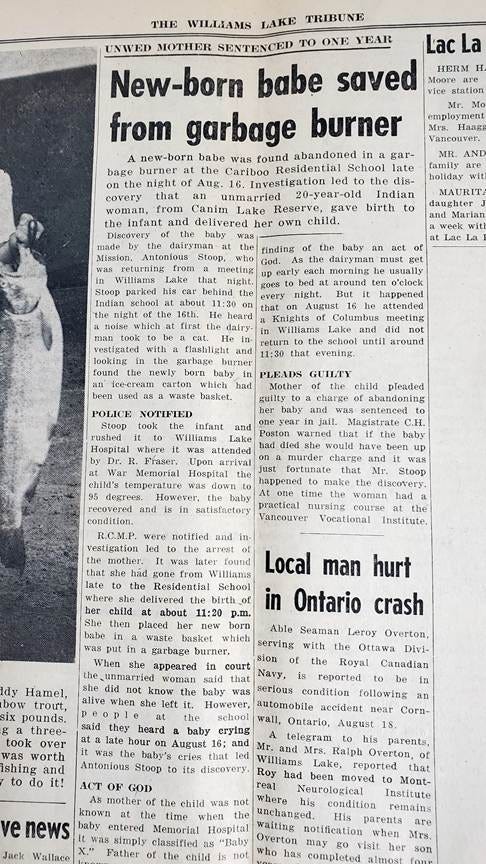
Note: This news story actually appears in “Sugarcane” - the thing that caught my eye as the camera pans over the article is that the unwed mother (Julian’s grandmother, Antoinette Archie) was 20. Students could only attend IRS until age 16. Antoinette is never identified by name in the film though she appears a number of times in public settings and a couple of times inside her home with the onscreen title of kyé7e (grandma in Shushwap). The way the film is woven together, virtually all film critics got the impression that Antoinette was raped by a priest as a student at the school, which is not the case. Here’s an example from the Christian Science Monitor.
That, of course, is not the story told in the fatuous Oscar-nominated shock-u-mentary, “Sugarcane” – it’s the opposite! The filmmakers insinuate that Ed was the only baby to survive being put in the incinerator by evil priests and nuns, when he was actually put there by his desperate, unwed, perhaps-in-shock mother! His mother who was 20 years old and not a student at the school at all! It appears to me that she may have gone into labour on her way home from Williams Lake to Canim Lake and pulled in to St. Joseph’s where she knew there was an infirmary. Antoinette had taken a practical nursing course in Vancouver and knew what to do; perhaps she hoped her baby could be set up for adoption? But then upon delivery, she believed the baby had died. That’s what she told the court. They sent her to jail for a year. This was a traumatic, humiliating event that she, a devout Catholic, had prayed about every day since, as we learn at the end of the film. She did not want to even talk about it! So, the filmmakers just made a grim fairy tale film their way anyway.
No respect. Little truth.
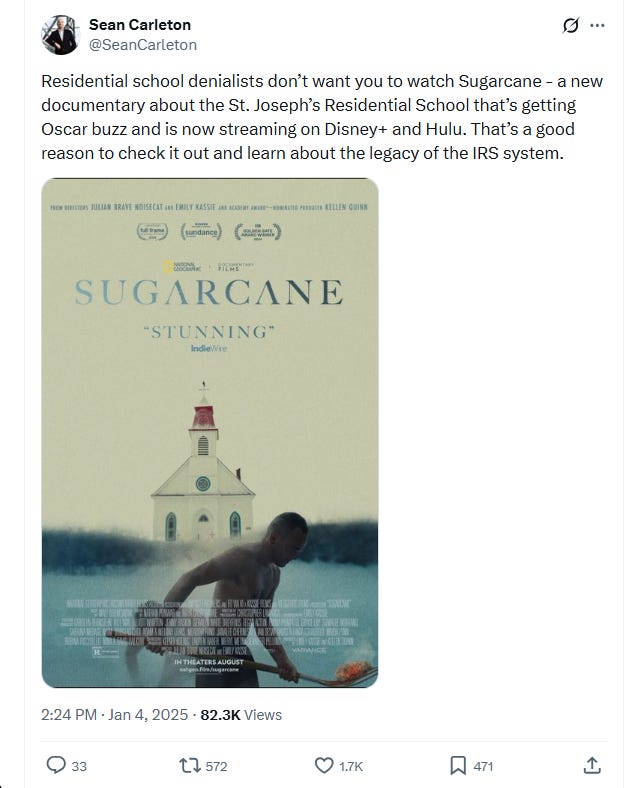
All very tragic. “Sugarcane” is not the truth; yet Sean Carleton posted on X that “residential school denialists don’t want you to watch Sugarcane…” the film.
Like. Gotcha!


And BTW, Baby Ed’s father was not a priest but rodeo rider and backhoe operator, Ray Peters, who went on to father 17 (maybe even 19 Julian says in his book) other children with five different women, according to a National Observer article by Julian in 2020.
A Tom Cat. Not a priest.
Respect. Truth.
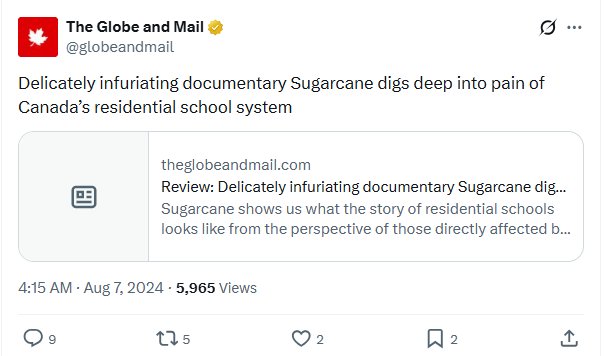
So, a documentary that skews the truth, does not respect kyé7e Antoinette’s painful secret of decades ago, and blood libels millions of Catholics and Christians in Canada, many of whom are Indigenous, and probably literally led to a number of church arsons because it is both an entrancing and enraging film if you don’t know the truth – and Sean Carleton thinks ‘denialists’ don’t want you to see it – because he believes it presents the truth about Indian Residential Schools when it is a woven mess of innuendo wrapped around two points of truth. Yes, a baby was found in an incinerator. Yes, there was a priest who broke his vows and had a consensual affair with an Indigenous staff member who was 22 years old; she had a child which was adopted out. That’s not evidence of on-going genocide or incinerated babies.
Truth. Respect. Ha.
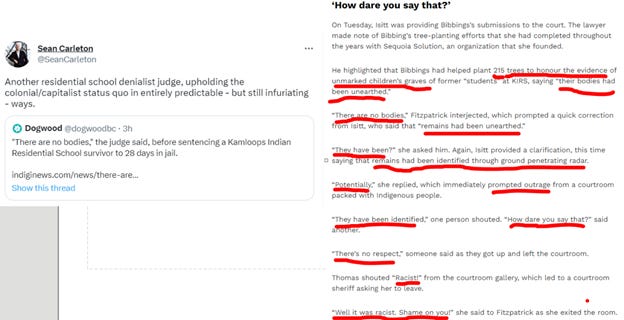
There’s more I could unpack from the Sinclair/Carleton screed, but that’ll do for the day.
Watch my no-budget mini-doc rebuttal to “Sugarcane”. Imagine, I’m up against documentary giant National Geographic and Carleton thinks I’m living large on clicks. I haven’t even monetized any of my sites.
Truth and respect before reconciliation.
Watch my documentary here:
https://rumble.com/v5i558i-the-bitter-roots-of-sugarcane.html
You are wonderful, Michelle, to keep plugging away with such steadfast respect to the facts.
Michelle, you deserve a medal.